Friday Night Lights In Palmer!
- Eric Bleicher
- Nov 30, 2025
- 4 min read

Updated: Nov 30, 2025
Weather continues to be a challenge here in the Anchorage/Mat-su area, and this week was no exception. We did have some enhanced solar winds throughout a good chunk of it due to a high speed stream from a coronal hole as well!
On Friday, I was able to get a weather window for a few hours, and catch some of the tail end effects of that high speed stream!

I chose the same general area that we shot at during the November 11 solar storm, and as hoped, it was much less crowded.
This is one benefit of these high speed streams and enhanced winds - if they aren't strong enough to trigger alerts for KP indices meeting active (4) or G1 (5) conditions, not as many casual watchers will be out.

Our First Looks
We decided to pack up and head out around 745pm, with modest enhanced solar wind (600km/sec) being a confirmation of the high speed stream effects. Polarity of the solar wind was also good (-), a key supporter of connection with Earth's magnetic field.
Webcams in our area confirmed aurora in the sky, which was very modest, about 45min later - that put us in place to start scoping & checking our lines of sight around 845pm. The moon was around 50%, and served as a really nice backlight in pretty warm temperatures (+20F), but as always with the moon it does produce some diffusing effects on visible aurora when it's more on the background activity side.
How Substorms Work

Fundamentally, there are three components to a substorm: 1) Growth phase - this is where the aurora is 'charging.' Faint, static aurora that's hanging in these arc/lasso type shapes (with varying brightness) is as clear of a signal as you can get! 2) Expansion phase - when the aurora brightens, moves, and is active 3) Recovery phase - the period right after an expansion where the aurora needs to essentially 'recharge.' Very diffuse, fragmented, and sometimes pulsating aurora are signs in the sky that the recovery phase is underway.
Another Clear Cue - 'Beading' In The Aurora
Auroral 'beads' can also be a really clear cue to a substorm transitioning into the expansion phase.
Here in the frame below, you'll see I've circled where beading was happening in that second arc which formed in front of the first over time. The initial arc had also shifted quite a bit, with that slow movement supporting the thesis - all you have to do is wait when you see these!
Once you see the beads form, that expansion phase is imminent. They look like small pillar type shapes, in sequence, within the arc, and will be a bit brighter than the primary structure.

It's also important to note that beading, just like anything involving the aurora, doesn't 100% guarantee one thing or another.
I've seen these quite a few times over chasing the last few years, and the range of outcomes has been quite wide - anything from a failed substorm (where the arc dies out after beading and you get nothing) to the aurora going nuts! It's simply an indicator of the energy release commencing, and the million dollar question is how much energy is there to be released, and are the conditions right for a release that produces optimal aurora viewing opportunity.
Start To Finish
The Recovery Phase
One of my favorite things to see under the aurora is actually the recovery phase, where you have this very fragmented look in the aurora. It's particulary cool when it pulses in the sky, and you're able to watch these fragments of disbursed energy look like they're 'short circuiting' overhead.
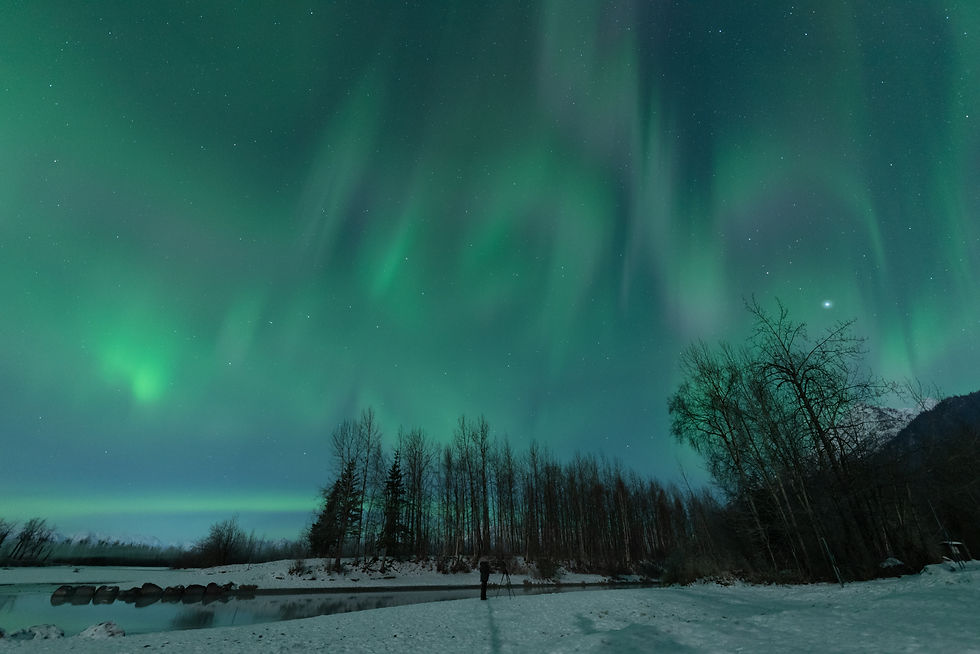
Here's an example of what it looked like overhead - the aurora ran across the sky quite rapidly, pulsing as it moved, and did this for about 15-20min.

I was honestly shocked at how quick the recovery was, with more brightening occurring pretty quick!
This is one shot here that I did up from immediately after the initial substorm recovery.

Coming Up Next - Two Large Active Regions & Excitement!

There's quite a bit of buzz as large, complex active regions rotate into Earth view, and with good reason (bottom left).
One of these active regions (4294 + 4296) delivered that big solar storm on the 11th, and it has folks excited to see what comes next!
They rotate fully into our view over the next day or two, and then take two weeks to transit to the opposite limb, and all we can do is wait to see what it may produce!
We also have a coronal hole (black, center) starting to transit the Earth strike zone! This supported us catching what we caught on Friday night, and may continue to produce enhanced winds - so high and upper mid latitudes could be in for some more action this week!
As for me, we're dealing with some freezing rain/snow mix, and the weather looks to be poor through to Thursday night as of now. This weekend the weather forecast is quite good for most of the state though, so I may take a longer trek depending on what happens!


